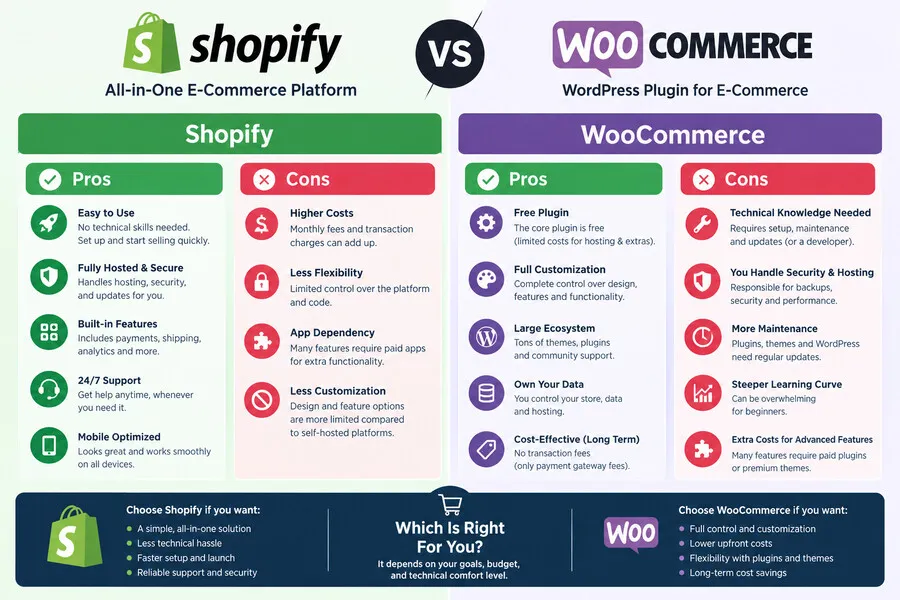


I am going to say something upfront that most comparison articles will not.
There is no universally better platform.
Not in 2026. Not ever.
The right answer to Shopify vs WooCommerce depends entirely on your business model, your technical confidence, your growth stage, and what you actually need your store to do.
What I can do — after years of building eCommerce stores for clients across New York and worldwide at Top New York Web Design — is tell you exactly what each platform does well, where each one falls short, and which type of business owner belongs on which platform.
No affiliate bias. No sponsored recommendations. Just honest, experience-backed guidance from a team that has built on both platforms extensively.
Here is our honest verdict on Shopify vs WooCommerce pros cons 2026.
What Has Changed in 2026
Before the comparison, let us acknowledge what is new this year. Because 2026 is not 2023.
On the Shopify side: Shopify Magic — their AI feature suite — now covers product description writing, email campaign generation, analytics summarisation, and customer service automation. All built into the platform at no additional cost. That is a significant capability upgrade that WooCommerce cannot match natively.
On the WooCommerce side: WooCommerce POS was discontinued in February 2026. If you need in-person selling alongside your online store, you now need a third-party app — with Lightspeed POS at $249 per year being the most recommended option. This is a meaningful change for retail businesses.
The market picture: WooCommerce holds 38.76% of the global eCommerce platform market. Shopify holds 27%. But those numbers tell only part of the story — WooCommerce’s larger share is driven by its long tail of small and medium stores, while Shopify’s 27% represents a more concentrated, higher-revenue merchant base.
Both platforms are growing. Global eCommerce GMV continues expanding at 8 to 10% annually. The debate is not about which platform is dying — it is about which one is right for you.
Now let us get into it.
What Is Shopify?
Shopify is a fully hosted SaaS — Software as a Service — eCommerce platform. You pay a monthly subscription. Shopify handles hosting, security, software updates, and infrastructure. You focus on your products and your customers.
It is purpose-built for selling. Everything from checkout to inventory to payment processing is designed around the eCommerce experience from day one.
Shopify Pricing in 2026:
| Plan | Monthly Cost | Transaction Fee |
|---|---|---|
| Starter | $5 / month | 5% |
| Basic | $29 / month | 2% (0% with Shopify Payments) |
| Shopify | $79 / month | 1% (0% with Shopify Payments) |
| Advanced | $299 / month | 0.5% (0% with Shopify Payments) |
| Shopify Plus | $2,300 / month | 0.15% |
All-in typical monthly cost: $50 to $75 per month for most small to medium stores on the Basic or Shopify plan, including essential apps.
What Is WooCommerce?
WooCommerce is a free open-source plugin for WordPress. You own the code, choose your own hosting, and manage everything yourself — or pay someone to manage it for you.
It transforms a WordPress website into a fully functional eCommerce store. Because it is built on WordPress, it inherits WordPress’s enormous content management capabilities and its massive ecosystem of themes, plugins, and developers.
WooCommerce Core Costs in 2026:
| Item | Typical Cost |
|---|---|
| WooCommerce plugin | Free |
| Domain name | ~$12 / year |
| Hosting | $5 – $25 / month |
| SSL Certificate | Free (most hosts include it) |
| Premium plugins | $0 – $200+ / month |
| Developer time | Varies |
Minimum production-ready cost: $25 to $35 per month for basic setups. A fully comparable setup to Shopify’s mid-tier plan runs $80 to $200 per month once hosting, premium plugins, and security are counted.
Shopify Pros & Cons 2026
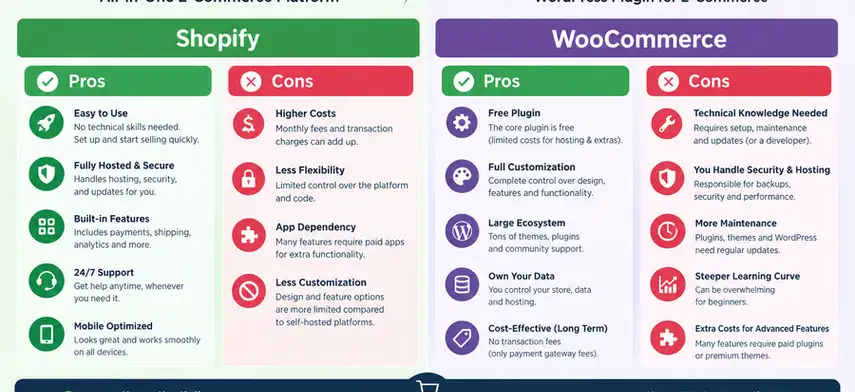
✅ Shopify Pros
Fast setup — no technical knowledge required. Shopify guides you through adding products, configuring shipping, and connecting payment from day one. No server configuration & No plugin conflicts. No PHP errors. A motivated first-timer can have a working store live in hours.
Built-in hosting, security, and updates. Everything is managed by Shopify. SSL, CDN, PCI compliance, software updates — all handled automatically. You never need to worry about your site going down because of a server issue you caused.
Outstanding performance out of the box. Shopify delivers a 1.8-second average page load without any optimization on the store owner’s part. Page speed directly affects conversion rates and Google rankings. Getting this for free — without touching any settings — is a genuine competitive advantage.
Shopify Magic — AI built in at no extra cost. In 2026, Shopify Magic bundles AI tools for product descriptions, email campaigns, analytics, and customer service automation directly into the platform. WooCommerce needs third-party plugins to access the same capabilities.
Shopify Payments — zero transaction fees. If you use Shopify Payments (available in the US, Canada, UK, and most major markets), transaction fees drop to zero. That saves hundreds to thousands of dollars annually compared to using a third-party payment gateway that triggers Shopify’s standard transaction fees.
World-class app ecosystem. Over 8,000 apps in the Shopify App Store covering every conceivable eCommerce function — subscription billing, loyalty programs, advanced analytics, dropshipping integrations, review platforms, and far more.
Shopify POS for in-person selling. Shopify’s point-of-sale system allows you to sell in person — at a market, pop-up, or physical store — and sync everything with your online store automatically.
24/7 customer support. Phone, chat, and email support available around the clock. When something breaks or you cannot figure something out, help is always available.
❌ Shopify Cons
Monthly costs add up fast. The headline $29 per month for Basic Shopify is misleading. Once you add the apps you actually need — email marketing, advanced SEO, subscription billing, reviews, upsells — real monthly costs quickly escalate to $100 to $200+ per month for most stores.
Transaction fees if you use a third-party gateway. If you cannot or do not want to use Shopify Payments — or if you operate in a country where it is not available — Shopify charges 0.5% to 2% transaction fees on every sale on top of your payment processor’s fees. At scale, these fees become extremely significant.
Limited customisation without coding. Shopify’s architecture restricts how deeply you can customise certain elements — particularly the checkout, URL structure, and product page templates — without either coding expertise or expensive third-party apps.
URL structure is locked. Shopify hard-codes URL paths — /products/ on product pages, /collections/ on category pages. You cannot change these. For advanced SEO practitioners and large catalogs, this structural limitation is a genuine frustration.
You do not own the platform. Your store exists on Shopify’s servers. If Shopify changes its pricing, discontinues a feature, or — in a worst case — closes your account, you have limited recourse. You are a tenant, not an owner.
App dependency creates cost creep. Many essential eCommerce functions require paid apps on Shopify. What WooCommerce delivers through free plugins often costs $10 to $50 per month per app on Shopify.
WooCommerce Pros & Cons 2026
✅ WooCommerce Pros
Complete ownership and control. You own the code, the database, and the data. Move hosts, switch developers, or modify any element of your store without permission from a platform provider. For businesses where data ownership is a legal or strategic priority — this matters enormously.
Superior SEO capabilities. WooCommerce runs on WordPress — the most SEO-capable CMS in the world. Full control over URL structures. Complete customisation of meta tags. Deep integration with Yoast SEO and RankMath. Schema markup control. No locked URL paths. For stores where organic search traffic drives meaningful revenue, WooCommerce gives you a stronger long-term foundation.
Free core plugin with massive ecosystem. WooCommerce itself is free. WordPress’s plugin ecosystem includes thousands of free and premium extensions covering every eCommerce function. Many capabilities that cost $20 to $50 per month as Shopify apps are available as free WooCommerce plugins.
Unlimited customisation. Because you own the code and have full access to the WordPress/WooCommerce codebase, there is no ceiling on what you can build. Custom checkout flows. Complex product configurations. Unique pricing structures. Member-only sections. Anything is possible with the right developer.
Cost advantages at scale. A $2M per year WooCommerce store saves $6,000 to $13,600 annually compared to the equivalent Shopify setup — enough to fund a part-time developer for ongoing optimisation. The economics of WooCommerce improve significantly as revenue scales.
Content marketing powerhouse. WooCommerce inherits WordPress’s best-in-class content management capabilities. If your eCommerce strategy includes blogging, long-form content, editorial content, or content-led SEO — WooCommerce is vastly superior to Shopify for managing that content alongside your store.
No platform lock-in. Your store exists on infrastructure you control. You are never at the mercy of a vendor’s pricing decisions or platform policy changes.
❌ WooCommerce Cons
Technical setup required. Installing WordPress, choosing and configuring hosting, setting up WooCommerce, configuring SSL, connecting payment gateways, and optimising performance adds hours of setup work before you sell a single product. Non-technical users genuinely struggle with this.
You manage everything. Security updates, plugin updates, hosting performance, backups, malware scanning — all of it is your responsibility. Or your developer’s responsibility. Either way, it is ongoing work and ongoing cost that Shopify eliminates entirely.
Performance requires optimisation. Only 51% of WooCommerce stores achieve sub-second page load speeds after optimisation. Shopify achieves 1.8 seconds average without any effort. Getting WooCommerce to perform at Shopify’s level requires caching plugins, image optimisation, a quality CDN, and a good hosting environment — and ongoing maintenance to keep it there.
Plugin conflicts and technical debt. WooCommerce sites can accumulate plugin conflicts over time — especially as the store grows and more plugins are added. A site weighed down by conflicting plugins can become difficult to update safely. This is a genuine operational risk that Shopify’s managed environment eliminates.
WooCommerce POS discontinued in February 2026. In-person selling now requires a third-party app. Lightspeed POS at $249 per year is the most recommended option. This is a meaningful additional cost and integration complexity for retail businesses.
Hidden total cost of ownership. WooCommerce’s free core is misleading. Once hosting, security, premium plugins, and developer time are counted — the true cost often rivals or exceeds Shopify at scale. The transparency advantage disappears when the full cost picture is considered.
Head-to-Head Comparison: Shopify vs WooCommerce Pros Cons 2026
| Category | Shopify | WooCommerce | Winner |
|---|---|---|---|
| Ease of Setup | ✅ Hours to launch | ❌ Days of setup | Shopify |
| Monthly Cost (small store) | $50–$75/month | $25–$35/month | WooCommerce |
| Monthly Cost (at scale) | Higher with fees | Better economics | WooCommerce |
| Performance | ✅ 1.8s avg — no effort | ⚠️ Requires optimisation | Shopify |
| SEO Control | ⚠️ Limited URL control | ✅ Full SEO control | WooCommerce |
| Customisation | ⚠️ Limited without coding | ✅ Unlimited | WooCommerce |
| AI Features (2026) | ✅ Shopify Magic built-in | ❌ Third-party only | Shopify |
| Security | ✅ Managed by Shopify | ⚠️ Self-managed | Shopify |
| Content Marketing | ⚠️ Basic blog | ✅ WordPress CMS | WooCommerce |
| Data Ownership | ❌ Shopify owns infra | ✅ You own everything | WooCommerce |
| Support | ✅ 24/7 included | ⚠️ Community + paid | Shopify |
| Transaction Fees | ⚠️ 0.5%–2% (no Shopify Pay) | ✅ Zero platform fees | WooCommerce |
| In-Person Selling | ✅ Shopify POS | ⚠️ Third-party needed | Shopify |
| Plugin/App Ecosystem | ✅ 8,000+ apps | ✅ Massive free ecosystem | Tie |
| Scalability | ✅ Fully managed scaling | ⚠️ Requires hosting upgrade | Shopify |
Who Should Choose Shopify in 2026?
Choose Shopify if you are:
A first-time eCommerce store owner who wants to focus on products and customers — not servers and plugin conflicts. Shopify’s setup speed and zero technical overhead is genuinely transformative for non-technical founders.
A fast-moving DTC brand that needs to launch quickly, iterate fast, and scale reliably without hiring a technical team. Shopify’s managed infrastructure means you never slow down for technical reasons.
A business that needs in-person selling integrated with online. Shopify POS is the most seamless omnichannel solution in the market.
A store doing under $500K annually that values simplicity, predictable costs, and round-the-clock support over maximum cost efficiency or ultimate customisation.
A brand that wants AI tools without configuration. Shopify Magic in 2026 delivers genuine AI capabilities for product copy, email, and analytics without installing or paying for any additional tools.
Who Should Choose WooCommerce in 2026?
Choose WooCommerce if you are:
An established WordPress user who already understands the platform and wants to add eCommerce without rebuilding their entire web presence.
A content-led brand where blogging, editorial content, and SEO-driven traffic are central to your eCommerce strategy. WordPress + WooCommerce is the most powerful content-commerce combination available.
A technically capable team — or a business with developer resources — that wants full control over code, customisation, and data without platform restrictions.
A store doing over $500K annually where the economics of WooCommerce’s lower platform costs become meaningful — saving $6,000 to $13,600 per year versus comparable Shopify setups.
A business with complex product structures — variable pricing, membership tiers, complex bundles, or highly bespoke product configurations — that Shopify’s structured architecture cannot accommodate without expensive apps.
A business where data ownership is a priority — legally, strategically, or competitively. WooCommerce is the only platform that puts you in complete control of your data.
Our Honest Verdict
After building eCommerce stores for clients across New York and worldwide at Top New York Web Design — here is the honest, direct answer.
For most first-time store owners and growing DTC brands — choose Shopify.
The speed of launch, the built-in AI tools, the managed infrastructure, and the 24/7 support create an environment where you can focus entirely on what matters — your products and your customers. The total cost is higher than WooCommerce’s headline figure, but the time and technical headache you avoid is worth the premium for most businesses under $500K.
For established brands with developer resources, content-led strategies, or revenue above $500K — choose WooCommerce.
The SEO advantages, data ownership, customisation ceiling, and scale economics are real and meaningful. If you have the technical capability to manage it — or the budget to hire someone who does — WooCommerce delivers better long-term value and more strategic control.
The one decision we consistently see hurt businesses most?
Choosing WooCommerce because it is “free” without accounting for the real cost of hosting, plugins, security, and developer time. WooCommerce is not free at scale. Budget honestly before you commit.
How Top New York Web Design Can Help
Whether you choose Shopify or WooCommerce — the platform is only as good as the store built on it.
At Top New York Web Design, our team builds high-performance, conversion-optimised eCommerce stores on both platforms. We help New York businesses and global brands choose the right platform, build it right from day one, and grow it intelligently over time.
Our eCommerce services include:
- Custom Shopify store builds — from scratch or Figma designs
- Custom WooCommerce store builds — full WordPress integration
- Shopify to WooCommerce migrations and WooCommerce to Shopify migrations
- AI-powered eCommerce development and automation
- SEO, Google Ads, and digital marketing alongside development
- Ongoing store management and optimisation retainers
- Serving NYC clients and businesses worldwide
If you are unsure which platform is right for your specific business — we offer free consultations that help you make the right decision before you spend a dollar on development.
Do not let the platform decision slow you down. Visit topnewyorkwebdesign.com and let our team help you build something that sells.
About Top New York Web Design Top New York Web Design is a full-service web design and eCommerce development agency based in New York City. Specializing in custom Shopify and WooCommerce development, AI-powered web design, SEO, and digital marketing, they serve clients across New York and worldwide. Visit topnewyorkwebdesign.com to get started.